

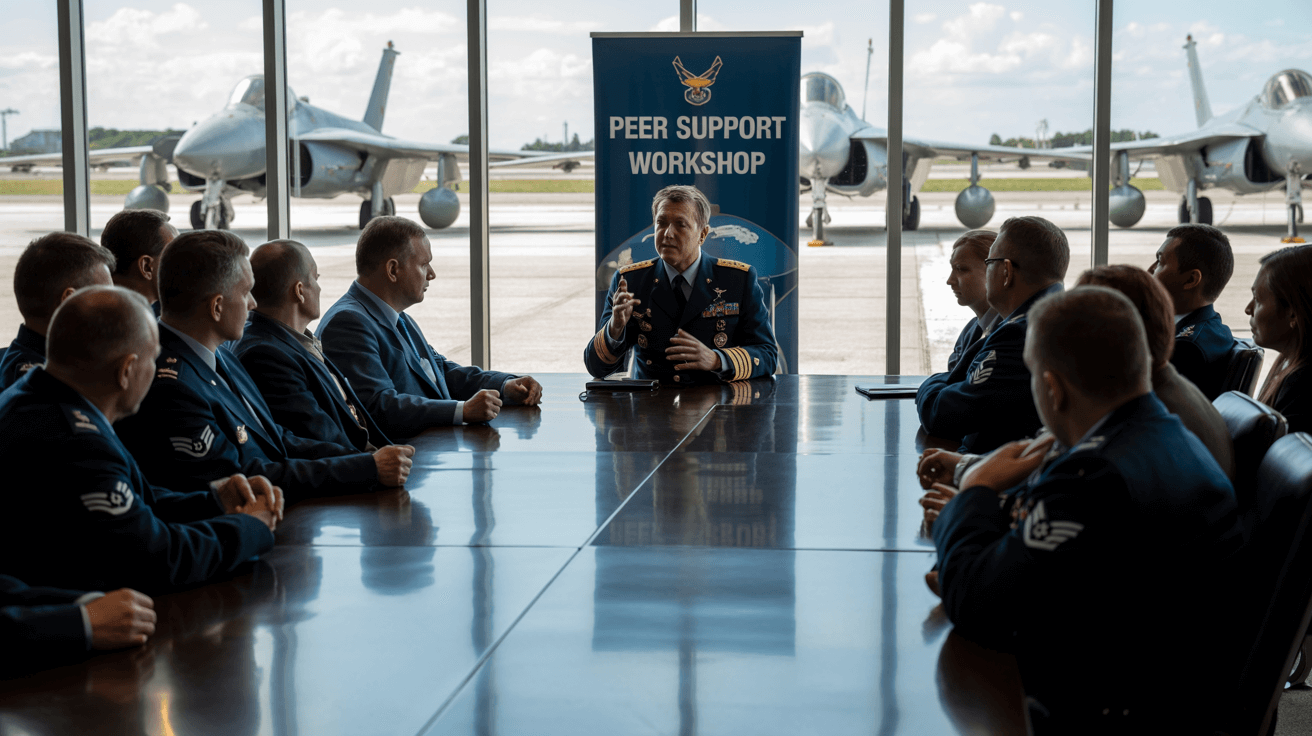
Grounding guidance for life after service.
Leaving the military is not just a career change. It can also be a shift in identity, rhythm, community, and purpose. This workshop was built to support that transition with practical reflection, structure, and encouragement.
As part of our Educational Consultant Support program, this resource is not centered on business plans or inspection tools. It is centered on helping veterans reconnect with stability, mission, and a sense of direction after service.
Four transition phases designed to help veterans find steadier footing
The workshop is organized around the inner and outer shifts that often come with life after service. Each phase is meant to help veterans make sense of change, rebuild momentum, and move toward a new mission with more intention.
Identity Shock
Understand how your military role shaped your mindset—and what can happen internally when that uniform comes off.
Routine Rebuild
Learn how to structure your days after service in ways that create stability, direction, and practical momentum.
Skills Translation
Reframe leadership, discipline, and operational experience in civilian terms that make your strengths easier to see and use.
Redefining Purpose
Channel your service mindset into mentorship, ownership, family leadership, and meaningful civilian missions.
Five small truths that can make the transition feel less heavy
Some truths are simple, but still hard to hold onto in the middle of change. This section is built to offer perspective without pretending the process is easy.
Experiences that reflect what transition can feel like
These reflections point to something many veterans recognize: the challenge is not only leaving a role, but learning how to explain your experience, rebuild connection, and find a new mission.
I thought leaving the Marines would be the hardest part. Turns out, explaining what I’d done—and who I was—was even harder. Finding a new mission saved me.
— Mike, USMC (Ret.)
No one told me the silence would be the toughest part. I went from 60 people around me every day to zero. Rebuilding connection was slow—but crucial.
— Angela, USAF
This is not the end. It is a retooling of what you already carry.
Transition does not erase your past. It asks you to reinterpret it. The discipline, clarity, responsibility, and mission-focus that shaped you in uniform can still serve you powerfully in civilian life.
This workshop is meant to help veterans take those strengths and apply them in new ways—through family leadership, mentorship, community, business ownership, or other meaningful civilian missions.
The goal is not to become someone completely different. It is to build a life that still feels aligned with what matters most.
Common questions about the Veteran Transition Workshop
These answers are here to make the workshop feel clearer and more approachable before you decide whether to engage with it.
Is this a business pitch? +
No. This workshop is presented as a values-based resource focused on post-service identity, purpose, and transition support.
Do I need to want a franchise to attend? +
No. It is intended for transitioning service members and veterans regardless of the career path they are exploring.
Is it live or self-paced? +
Both options are offered, with video-based and group formats available depending on preference.
Who created the content? +
The curriculum is described as a collaboration between veterans, mental health professionals, and educational consultants.
Can family members join? +
Yes. Partners and close family members are encouraged to be part of the process.
You do not have to figure out life after service alone.
This workshop exists to help veterans find steadier footing, clearer language, and a renewed sense of mission after military service. If you want support, reflection, and a path forward, start the conversation.